

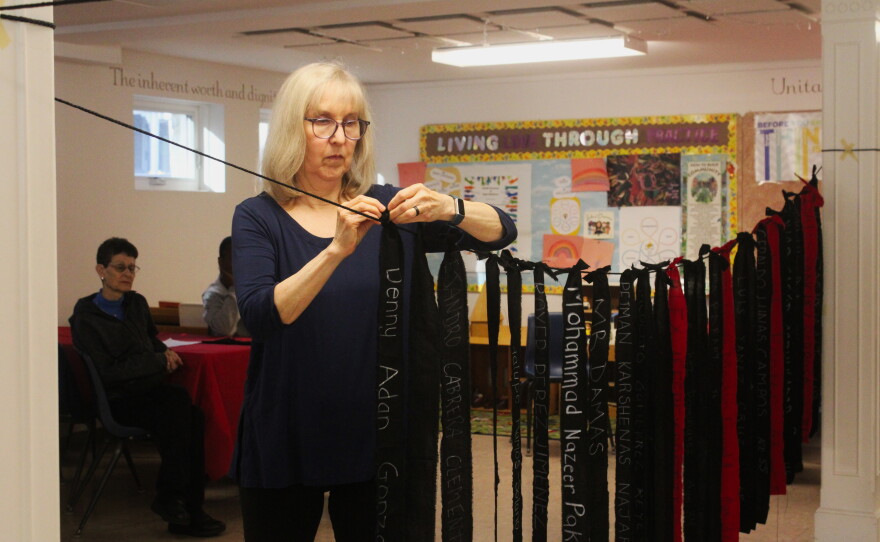


Dozens of New Hampshire faith communities are gathering to make memorials for people who have died in ICE detention or been killed by immigration agents since the start of the second Trump administration. The project “Refusing to Forget” invites communities to make flags by tearing cloth and writing the names of the departed on the fabric.
“In all religious traditions, we affirm that human life is sacred,” said Rev. Mark Koyama of the United Church of Jaffrey, who developed the project alongside Pastor Traceymay Kalvaitis of the Dublin Community Church and the Granite State Organizing Project.
“If there's a government that points to a certain kind of people and says ‘those people are disposable,’ that is immoral and sinful according to all religious traditions. And so what we're doing is a sacred act, the sacred act of saying the names to remember, to refuse to forget.”
Koyama said that the prayer flags are a nod to the tradition in Tibetan Buddhism, where the fluttering flags symbolize sending prayers to the universe. From his own faith, Koyama said that tearing cloth is a symbol of mourning in the Bible and symbolizes the way that the departed were torn from their communities.

“Refusing to forget” flag displays have already been installed in several places, including the Unitarian Universalist Congregation in Milford, the Plymouth town common and the United Church of Acworth. In Milford, about 30 people gathered on Sunday to tear long strips of cloth, write the names, and display the flags in front of the church.
Nathalie Watson is a member of the Episcopalian church in Milford. She volunteered to read the names at a gathering on Sunday afternoon at the Unitarian Universalist church in Milford. As a child of immigrants, she said the experience was emotional for her.
“Whenever I hear someone is hurt by ICE, or there's an immigration issue, it always brings me back to my own personal story,” she said. “I did not know those people personally, but I can imagine how I would feel if it were someone in my community, or someone in my family.”

Another interfaith group held a service at the statehouse lawn on Sunday with music and a reading of the names. Divine Nkwelle, an organizer with the American Friends Service Committee, said that it was important to remember these people.
“Every life has value, even when we do not know the person's name, nationality, immigration, status, or circumstances. Human dignity should never depend on one's immigration status,” he said. “My hope is that our compassion gives us courage, and that may our love become visible in the way we protect one another.”


