


NHPR is proud to announce the launch of Cosmically Curious, a new space-focused segment hosted by Patrick McNameeKing. It's all about celebrating the night sky with a healthy dose of joy, curiosity and zero pretension.
Each week we’ll cover topics ranging from the latest NASA missions, to events happening in the night sky, to space in pop culture. It’s science for everyone—whether you’re an amateur astronomer or someone who’s never held a telescope.
Catch Cosmically Curious on Weekend Edition Sunday at 8:35 a.m. and again on Mondays during Morning Edition at 7:32 a.m. and 9:32 a.m.
Patrick will also be joined by a rotating cast of local experts:
- John Gianforte: Director of the UNH Observatory
- Nicole Gugliucci: Physics professor at Saint Anselm College
- Amanda Leith: Astronomer from the McAuliffe-Shepard Discovery Center
Got a Space Question? Email us at: Cosmic@nhpr.org
-
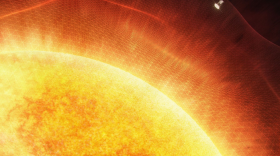 Does the cosmos preserves a record of everything that has ever happened?
 -
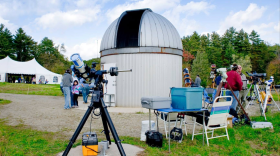 The University of New Hampshire's Department of Physics and Astronomy is hosting the New England Fall Astronomy Festival (NEFAF) in October.
 -
 In this episode of NHPR's Cosmically Curious, we explore the universal rules that define reality & physics.
 -
 Cosmically Curious host Patrick McNameeKing sits down with Saint Anselm College astronomer Nicole Gallucci to clear up some common black hole myths.
 -
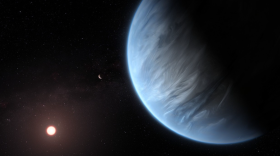 On the latest episode of Cosmically Curious, host Patrick McNameeKing sits down with John Gianforte from UNH to discuss why a distant exoplanet is making headlines.
 -
NASA’s Voyager probes are 16 billion miles away in interstellar space. Learn what the two instruments are still measuring and why it matters for deep space exploration.
-
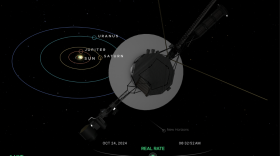 Find out how a rare planetary alignment made a four-planet grand tour possible, and how nuclear technology keeps these aging probes running deep in the cosmos.
 -
 In this segment of NHPR’s Cosmically Curious, host Patrick McNameeKing sits down with UNH astronomer John Gianforte to discuss an upcoming near-total lunar eclipse.
 -
In this edition of Cosmically Curious, we learn about the true source behind mysterious radio bursts.
-
 Learn the best viewing times, why a new moon makes this year special, and why you only need a lawn chair to watch.


You make NHPR possible.
NHPR is nonprofit and independent. We rely on readers like you to support the local, national, and international coverage on this website. Your support makes this news available to everyone.
Give today. A monthly donation of $5 makes a real difference.