

-
 NASA’s Voyager probes are 16 billion miles away in interstellar space. Learn what the two instruments are still measuring and why it matters for deep space exploration.
 -
Find out how a rare planetary alignment made a four-planet grand tour possible, and how nuclear technology keeps these aging probes running deep in the cosmos.


-
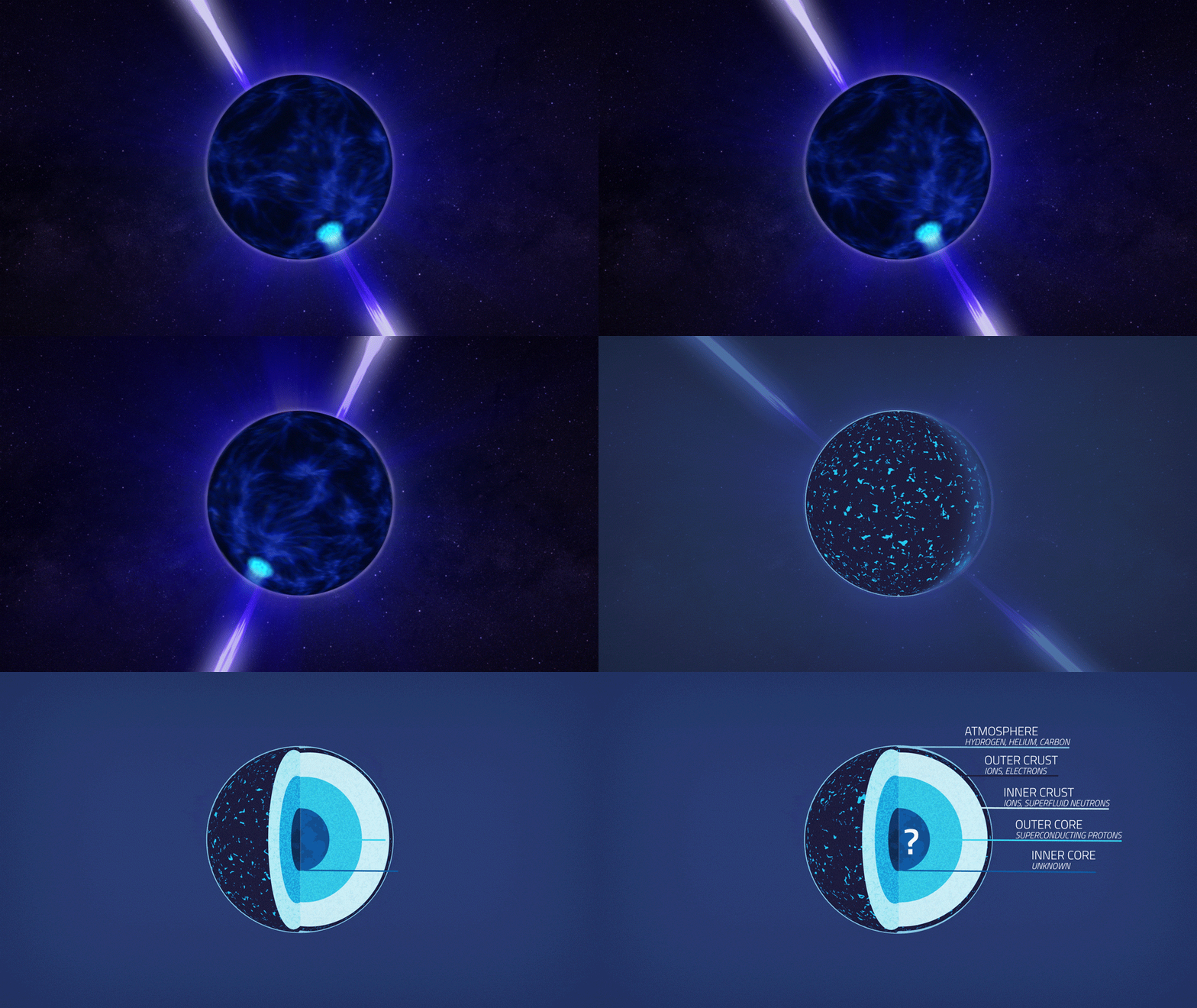 This week we explore why these collapsed stellar remnants are far more than just deep-space anomalies—they are actually some of the most powerful scientific instruments available to us.
 -
 Today, we're answering a question from listener Tim Smith, who asks: Why does anything exist?
 -
 How do you capture a full-color image when your recording medium can only see in black and white?
 -
 As private companies launch massive new fleets into orbit, we have to face a harsh reality: Space up there is not unlimited.
 -
 We talk a lot on this show about stars. But where do they actually come from? Host Patrick McNameeKing put the question to Jon Gianforte, an astronomer at the University of New Hampshire.
 -
 For this week’s Cosmically Curious, we check in with Nicole Gugliucci from Saint Anselm College to talk about how modern physicists tackle the ultimate origin story.
 -
Construction is currently underway in South Africa and Australia for the Square Kilometre Array (SKA), a massive radio telescope poised to revolutionize our understanding of the cosmos. Its primary target? Neutral hydrogen (H1).
-
 Physics professor Nicole Gugliucci explains the science of Star Trek’s warp drive, the Alcubierre concept, and why we're still far off from zipping through space.
 -
 Have you ever wondered how satellites stay on course when they are millions of miles from Earth? Recently, a listener named Don reached out to us with that exact question.
 -
 Whether you’re a budding scientist or just someone who loves a starry night, the Starlight Challenge is bringing the wonders of the cosmos to backyards across New Hampshire.


