

This story was originally produced by the Valley News. NHPR is republishing it in partnership with the Granite State News Collaborative.
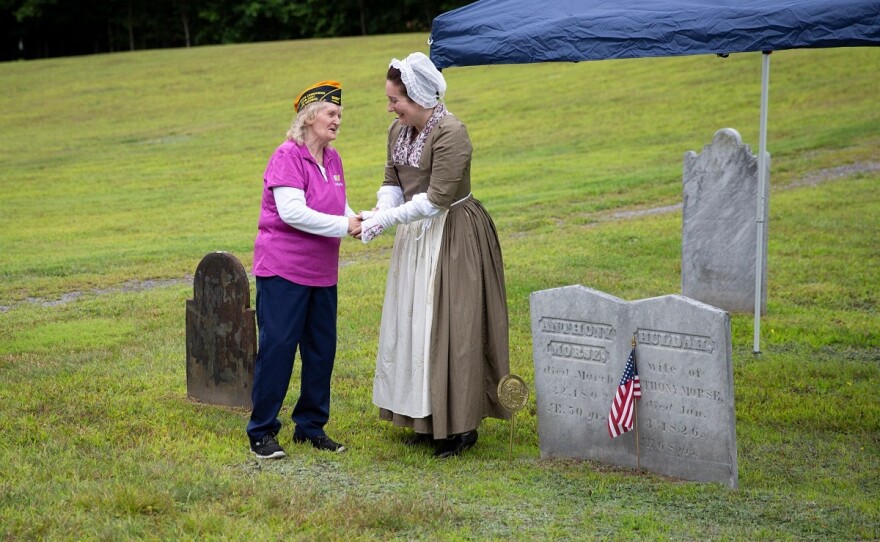
When researchers with the Boston Tea Party Ships & Museum went looking for someone in Sharon, Vermont, to help place a marker at Anthony Morse’s grave, they reached out to the person in charge of the cemetery where he’s buried. Nobody knew yet that she was his great-great-great-great-granddaughter.
“I never thought I would’ve found something like this,” Doris Backus, president of Pine Hill Cemetery, said of the discovery.
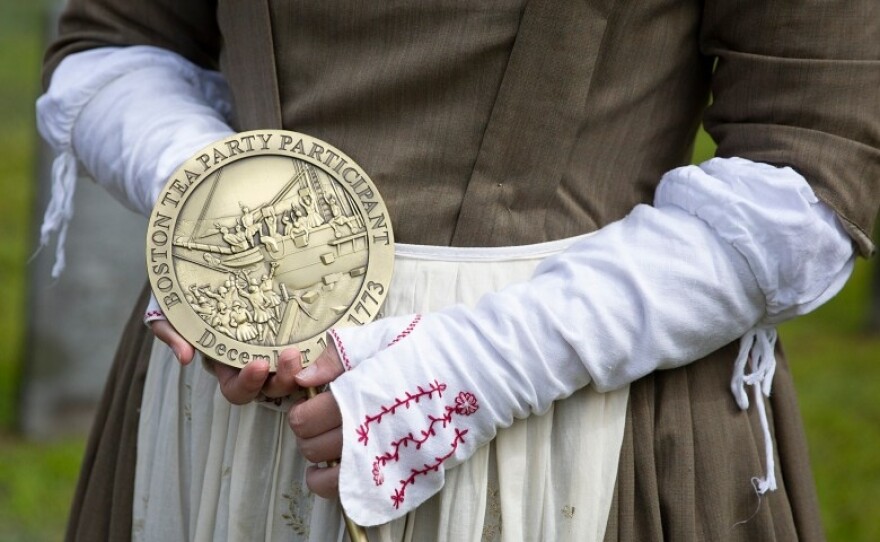
On Monday, Backus placed a bronze marker at Morse’s grave, 253 years after he waded into Boston Harbor and helped destroy 342 chests of British tea.
It made Morse the fourth confirmed Boston Tea Party participant in Vermont to be honored this way, part of a national effort that has placed roughly 70 markers over the past four years, according to Kristin Harris, research coordinator at the Boston Tea Party Ships & Museum, who first reached out to the town.


To place the marker herself, “meant a lot to me,” Backus said. “It’s awesome, it’s unreal to me.”
Morse was born in 1753 in Preston, Conn., and was about 20 years old and living in Worthington, Mass., when he joined the estimated 150 to 160 men who boarded three ships at Griffin’s Wharf on the night of Dec. 16, 1773.
Little is known about why he was in Boston that night, but he went on to serve in the Continental Army during the Revolutionary War. He later settled in Sharon, where he and his wife, Huldah, raised six children. He died in 1803.
“Anthony Morse was a revolutionary spirit,” said Evan O’Brien, creative manager for the museum.
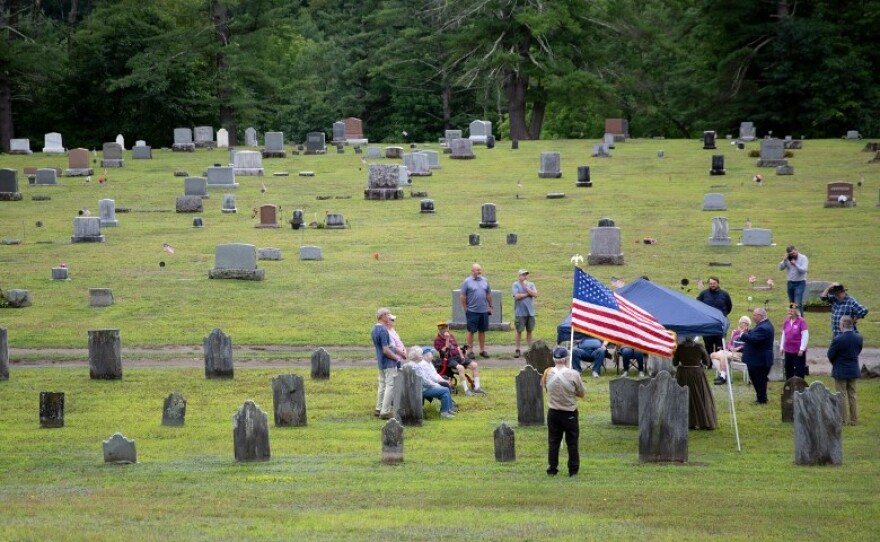
Jonathan Lane, executive director of Revolution 250, told the crowd gathered at the cemetery that marking these graves is less about the 18th century than the present one.
“In remembering it, we are doing a service not just to the people from 250 years ago,” Lane said. “We’re doing a service to ourselves, reminding ourselves what the best part of our nation is, what and where it comes from.”
The Boston Tea Party is remembered as a turning point on the road to the American Revolution. According to the American Battlefield Trust, 30 to 130 men, many of them Sons of Liberty, boarded three ships — including the Dartmouth, which shares a namesake with Dartmouth College — and dumped chests of tea into the harbor to protest taxes imposed without their consent.
Jonathan Lane, executive director of Revolution 250, told the crowd gathered at the cemetery that the story is deeper than the famous moments.
“The real story of the American Revolution is what happened in the hearts and minds of people all across America,” he said. “It’s in your town meetings, it’s in your legislatures, it’s in your churches — all the places where people gather, and people talk, and people remember what it was that the nation was founded upon.”


