




At Wolfe's Neck Farm & Campground in Freeport, a group of 30 volunteers are tromping through the mud flats at low tide, buckets in hand. Their goal is to get as many green crabs out of the environment as possible in one hour.
It's called a "green crab derby." Volunteers flip over rocks and rake through seaweed with their bare hands. Rachel Wheeler, who is up from North Carolina camping with friends, brought her young daughter along.
"Her name is Charlie, and we're going for the gold," she said.
There will be prizes for biggest crab, most crabs, and most soft-shell green crabs found.
Kate Masury found a pregnant female, which can carry 180,000 eggs.
"That could be a contender for biggest. And most!" she said.
Originally brought across the Atlantic Ocean in the 1800s by merchant ships, green crabs are now a real threat to the ecosystem. Warming waters due to climate change are allowing the population to explode, destroying habitat, and eating shellfish like softshell clams and wild mussels.
Invasive green crabs have been present in Maine's inshore waters for over a century. Now, as those waters warm, their populations are exploding — and they are taking over underwater habitat that is critical for native eelgrass and shellfish. But efforts are underway to both curb the numbers of green crabs, and also find commercial markets for the species.
The "Derby" is part of Green Crab Week: A regional summit at which stakeholders from all over the country share research, and possible strategies for controlling the species.
"I don't think that we're ever going to be able to eradicate green crabs," said Marissa McMahan, senior fisheries director at Manomet, a Massachusetts-based conservation group. “So, we're really at a place now where, they're here and they're here to stay, and we should figure out ways to benefit from them.”
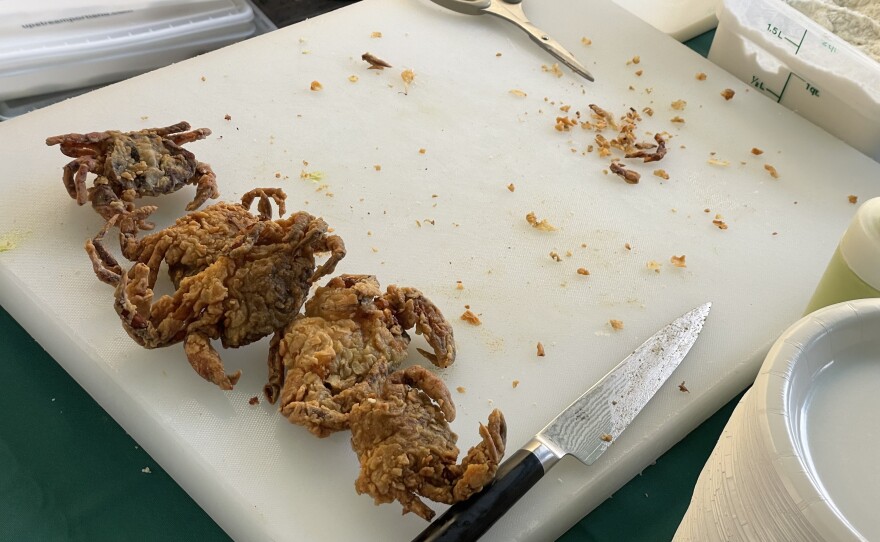
One way is to cook them.
Green crabs are commonly eaten in other parts of the world, said David Standridge, owner of the Shipwright’s Daughter restaurant in Mystic, Connecticut. Prepping for a cooking demo at a Green Crab Summit in Portland, he asked, why don’t we?
"They're actually highly sought after by the best chefs in Milan," he said. "They're a delicacy. It's not like some weird thing that no one eats anywhere that we're trying to get people to eat.”
Standridge said his restaurant just passed a milestone: 10,000 pounds of green crabs used in the last five years. He said it's a staple for crab stock, crab oil and other dishes when he wants a punch of seafood umami flavor.
“We have a really unique opportunity as chefs to influence the food system, because we can influence both sides," he said. "We can influence the customer base in developed markets by introducing them to new products, and then we can, in turn, influence the supply side by getting our suppliers to carry those products, or getting people to fish for those species.”
But Standridge and McMahan agree — it’s unlikely we’re going to eat our way out of the green crab problem.
Sam Cheeney of Milbridge, Maine has turned to green crab fertilizer. He sells what he calls "the Green Kraken," at farmers markets.
“The crab meal is what I like to say is meat and potatoes for your garden. It's bulk nutrients, so there's lots of nitrogen, lots of phosphorus. It's high in calcium, and it's got lots of trace minerals in it, because it's from the ocean."
Cheeney said the goal is to scale up to commercial sales, but, he still has a way to go.
Back at Wolfe’s Neck, the derby's grand prize went to three 7th grade farm campers, who collected 17 crabs. And the prize for biggest crab went to Eli Gladstone from northern British Columbia.
It wasn't his first rodeo. He said he's attended green crab derbies at home, where they're also battling the invasives.
"My mom actually teaches kindergarten, and even all her little kids, they all know what a green crab is, and they go on field trips to the beach, and they want to kill them, so I think that there's a lot of awareness in the community that way," he said. "It's really, really nice to see."
All the specimens collected will be disposed of or composted — though someone from Texas headed off with a large softshell green crab, planning to fry it up in cornmeal that evening.


