Summertime in New Hampshire means summer camp for thousands of students. While some kids are hiking mountains and swimming in lakes, nearly two dozen students spent part of this week trying to turn 200 tiny plastic pieces, springs, and screws into robotic cyborg hands.
Eleven-year-old Alexa Zaha was one of 21 students attending a U.S. Army-run camp in Hanover to help boost their skills in science, technology, engineering, and math, or STEM. She was struggling to fit a yellow plastic piece inside a hole that seemed too small.
When the 50-page manual didn’t answer her question, Zaha looked to Lillian Adamek, who sat across the table with her tiny pieces sorted into cups. They concluded that Zaha had neglected to cut off a tiny section of the yellow piece.
They both said this camp has taught them mistakes are part of learning, not a sign of failure.
“You're never going to get it the first try and it's so okay to get it the millionth try,” Zaha said.
The camp is hosted by the U.S. Army's Cold Regions Research and Engineering Laboratory in Hanover. Instructors tuck lessons on engineering, physics, and Newton’s laws into experiments that range from building rockets and robots to testing different materials in concrete.

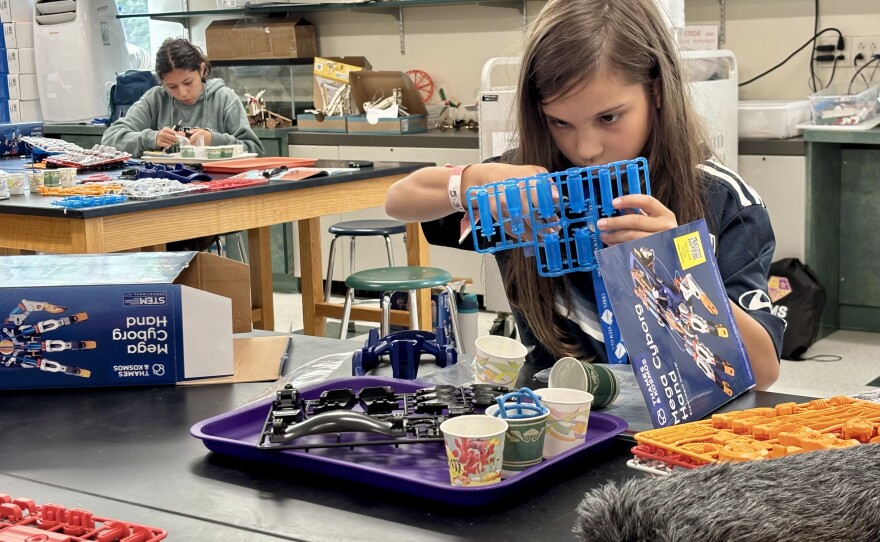


As he unpackaged his cyborg hand kit, Phineas Soucy, 12, of Hanover, said he signed up for the camp for two reasons:
“I like the engineering and working through tough problems,” he said.
This checked both of those boxes. Instructor Chris Charlebois, a recruiter for the research lab, gave students some advice.
“This is not a very quick build by any means,” he said. "Ask for assistance if you need to take a break because your concentration might wander a little bit. It happens. It's okay to take a break.”
Xera Wakeman, a 13-year-old from Sutton, wasn’t close to finishing her cyborg hand with only an hour to go. But there were no signs of stress or wandering concentration.
“It's fun and hard at the same time,” she said. “It's like a mix of both.”
The camp ended with a trip to the U.S. Army’s extreme weather research lab.