


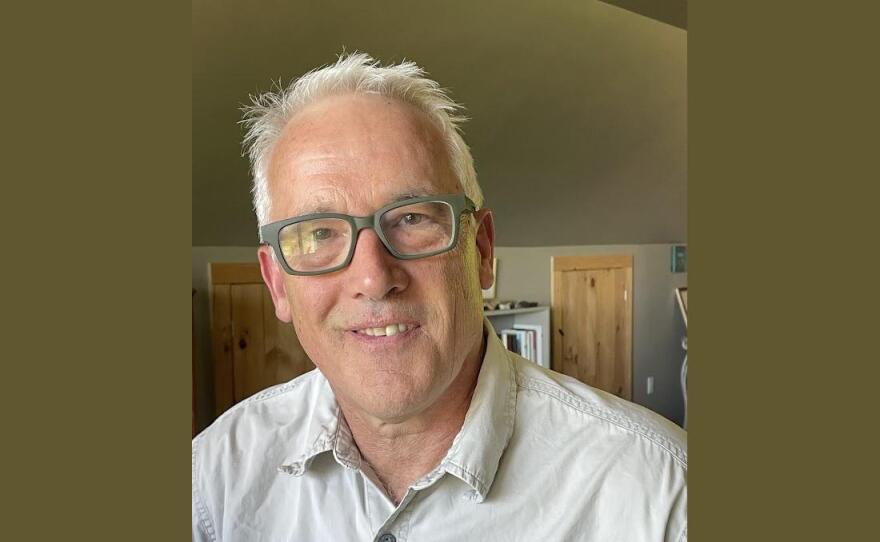

In the novel "The Gatepost," Vermont author Tim Weed takes readers from the hills of southern Vermont into a world of ancient artifacts, missing fathers, and questions about what survives us.
The story begins with a mysterious object connected to an ancient civilization but unfolds in a landscape that may feel surprisingly familiar to New England readers.
NEPM’s Carrie Healy visited Weed at his home in Putney, Vermont, where he wrote much of the novel. The novel revolves around a displaced object and deals with the modern, high stakes world of smuggling and sequestering ancient treasures.
Tim Weed on what inspired him to write this novel:
It was kind of inspired by several visits that I took to Oaxaca in Mexico, and I've always been interested in ancient cultures and in particular in ancient Mesoamerica. And so in Oaxaca, I got to visit a lot of great ancient Mesoamerican ceremonial sites. And I got to meet with a couple of traditional healers or curanderas, and also got to visit the Museo de Antropologia in Mexico City, which, as far as I'm concerned, is one of the great museums of the world, obviously full of these kinds of artifacts.
And, you know, the luminosity or the fact that these ancient artifacts, for whatever reason, tend to have kind of an aura or a sense of power that are associated with them because they had been used for years and years for shamanistic purposes, or just in general because of their antiquity. So that was kind of what drew me into it.
Weed has traveled around the world as a tour guide. Weed on why he decided to set this story in southern Vermont:
I was actually born in Vermont. I considered Vermont to be my home, and I have traveled around the world, and a lot of my fiction is set in different places.
This is my first book that was actually set in Vermont, and I intentionally wanted to do that because I love this place. When you're writing about things that are sort of stretching the boundaries of belief, I found you really have to root the story in something very familiar.
One of the settings is very contemporary Vermont kind of a normal rural place if you're used to living around here. But the other settings and the places that end up coming into it are quite distant and fantastical. And so I felt it was nice to have that grounding in something contemporary.
...throughout his adult life he'd been animated by a passionate desire to save humanity from what he saw as its rapidly approaching doom. This was the motivation behind his decision to quit academia and move up to Vermont, where he'd conducted an ambitious program of independent research on pressing ecological topics like the local effects of climate change, the causes of declining biodiversity, and the importance of soil microbes and mycorrhizal networks in plant growth and health. (basic facts about main character Esme's father from chapter 4;The Gatepost)
Weed’s book explores the theme of what survives us. The main character is looking for information about her father, who disappeared when she was a small child. Weed talks about his notion of legacy, both as a person and a writer:
In terms of of legacy, it's an interesting point because I've never really thought that that is one of the things that this book is about, but it really is. Right? We've got an ancient artifact. We've got an academic who's trying to make a contribution to the world that is lasting. And, in a sense, he's ambitiously trying to save the human species, if he can. And then you have a daughter who is also trying to write a book.
As to whether I would be able to answer a question about what legacy is or anything like that, I don't know. I mean, I think that the role of literature is not to provide answers, but to ask good questions.
The author spent hours a day writing about the place he calls ‘Granite World’ a hallucinatory illusion where things are not as they seem. And while he eventually would reenter the real world, Weed says he found the experience of writing a sort of escape:
I actually find that the time that I spend here in this space is kind of an escape. I suppose you could say it's also a meditation. It's also my own form of therapy.
I happen to really love granite, and this is a little bit, you know, nerdy [but] I love rock and particularly like granite. I just love the touch of, the feel of it, the antiquity of it, the way that lichen grows on it, the way it looks, the way you can shape it. So Granite World for me was not scary. Yes, of course [it was] but it was also visiting a place that I enjoyed describing and enjoyed ...sort of inhabiting.
Tim Weed is the author of "The Gatepost."


